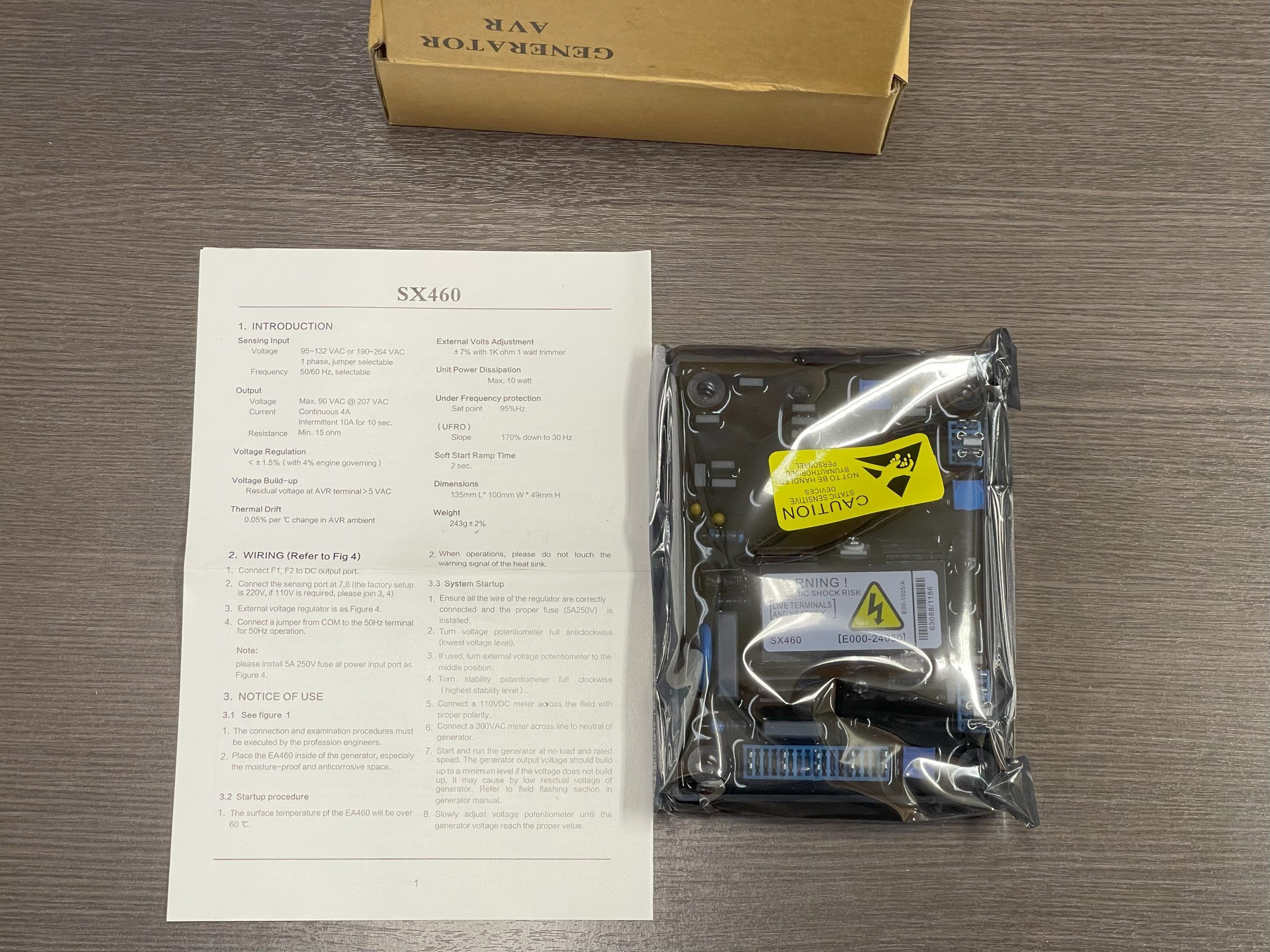
The AVR SX460 is one of the most widely recognized automatic voltage regulators in the standby and prime-power generator world. Originally a Stamford (now Cummins Generator Technologies) design, the SX460 is a compact electronic board that sits inside the alternator’s terminal box and keeps the generator’s output voltage steady as the load changes. Because it has been in service for decades and is fitted to countless mid-size brushless alternators, it is also one of the most commonly sourced spare parts, with genuine Stamford/AvK units alongside a large market of compatible replacements.

This guide is written for generator technicians, facility maintenance staff, and buyers who need to understand what the SX460 actually does, the parameters that matter when specifying or replacing one, and the wiring and safety points that separate a clean swap from an expensive mistake. It is based on manufacturer documentation and public product data, not on bench testing.
What the SX460 does
An automatic voltage regulator is the brain behind a brushless alternator’s excitation system. On a self-excited machine, the SX460 draws its own power directly from the alternator’s main output terminals, senses the output voltage, and continuously adjusts the current it feeds to the exciter field. That exciter output is rectified by the rotating diodes on the shaft, which in turn magnetizes the main rotor field. In plain terms: the AVR is a closed-loop controller that trims field strength hundreds of times a second so terminal voltage stays on target whether the generator is idling under no load or being hit with a large motor start.
The SX460 is a half-wave, phase-controlled thyristor regulator with single-phase sensing. Single-phase sensing keeps the wiring simple and is perfectly adequate for the balanced or lightly unbalanced loads most gensets in this class carry. It is a self-excited (shunt) design, which means it needs a small amount of residual magnetism to begin building voltage; the datasheet notes a build-up voltage of about 4 VAC at the AVR terminals to get the process started.
Specifications at a glance
| Parameter | Specification |
|---|---|
| Type | Half-wave phase-controlled thyristor AVR, self-excited |
| Sensing input | 95–132 VAC or 190–264 VAC, 1 phase (jumper selectable) |
| Sensing frequency | 50/60 Hz nominal |
| Power input | 95–264 VAC max, 1 phase, 50/60 Hz |
| Power output | Max 90 VDC at 207 VAC input |
| Output current | 4 A continuous, 6 A intermittent (10 s) |
| Field resistance | 15 Ω minimum |
| Voltage regulation | ±1.0% RMS (with 4% engine governing) |
| Thermal drift | 0.05% per °C change in ambient |
| Under-frequency (UFRO) | Set point 95% Hz, slope 170% down to 30 Hz |
| Response time | AVR 20 ms; field current 90% in 80 ms; volts 97% in 300 ms |
| External voltage trim | ±10% with 1 kΩ 1 W trimmer |
| Power dissipation | 10 W maximum |
| Operating temperature | −40 °C to +70 °C |
| Storage temperature | −55 °C to +80 °C |
Key features and control parameters
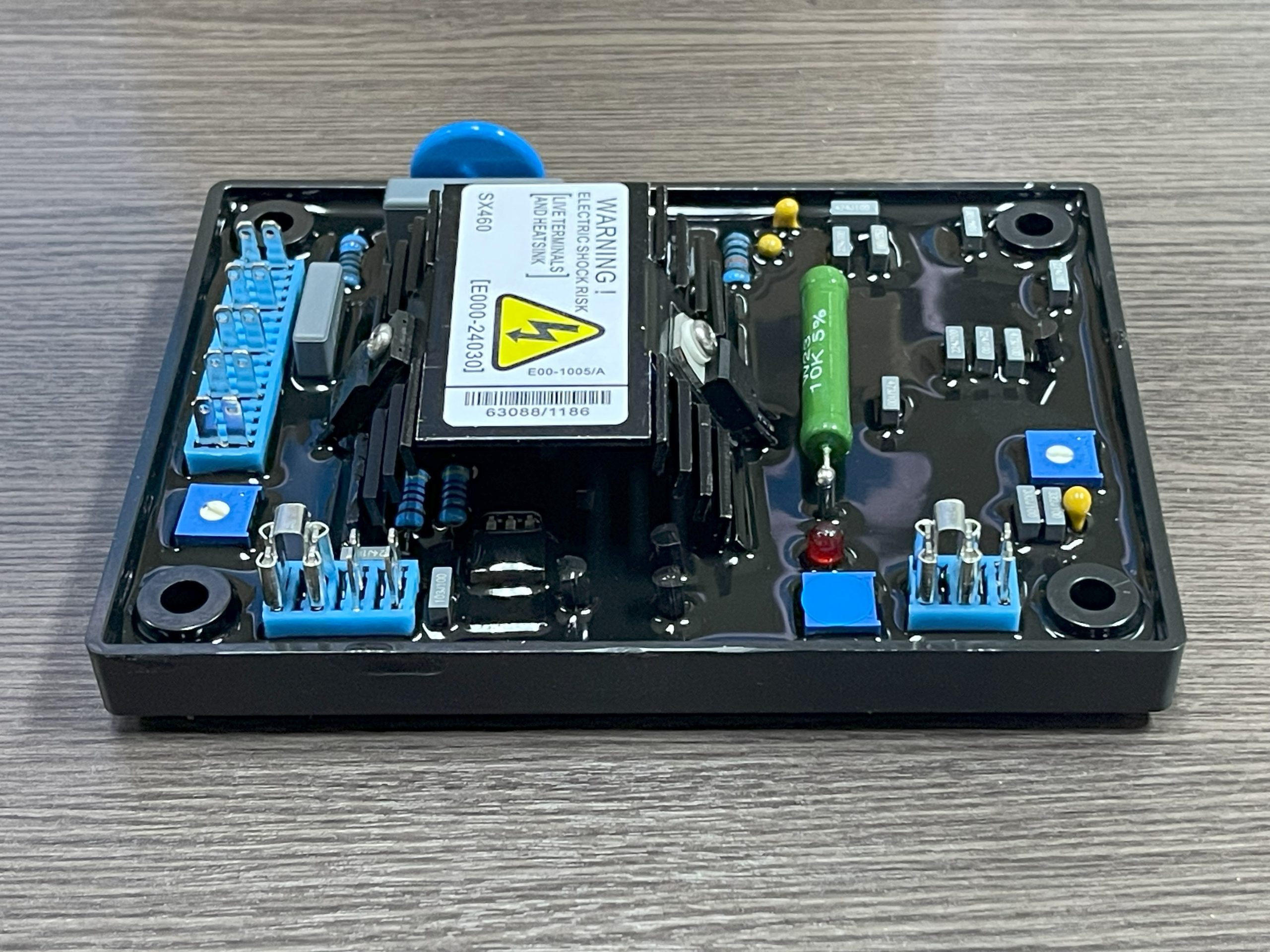
The SX460 exposes four field-adjustable controls, and understanding them is the difference between a correctly commissioned alternator and one that hunts or trips. The VOLTS potentiometer sets the nominal output voltage; on the manufacturer’s setup procedure you start it fully counter-clockwise and turn it clockwise until a voltmeter across one phase and neutral reads rated voltage. An optional external hand trimmer gives operators a ±10% adjustment range using a 1 kΩ, 1 W potentiometer without opening the AVR enclosure.
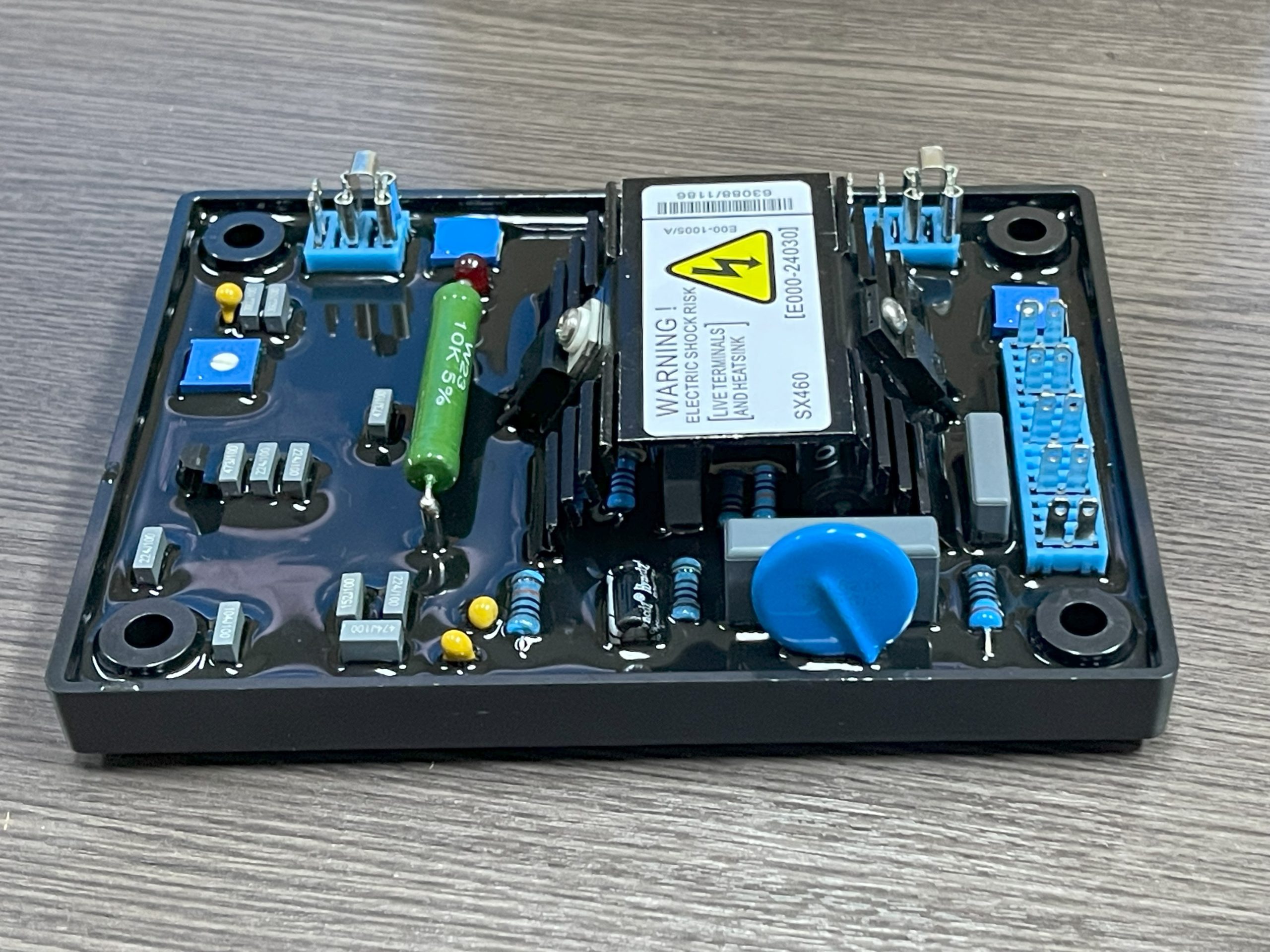
The STABILITY (STAB) control tunes the damping of the control loop. Set it wrong and the voltage “hunts,” swinging above and below target; turning the pot clockwise increases the damping effect to settle it. The UFRO control (under-frequency roll-off) is arguably the most important protection feature. When engine speed and therefore frequency drop under heavy load, the AVR reduces output voltage proportionally instead of trying to force full excitation into a slowing machine. The factory set point is 95% of nominal frequency with a steep 170% slope, and an on-board LED lights whenever the unit is in the UFRO region, giving a quick visual cue that the engine is being pulled down. Jumper links select 50 Hz or 60 Hz operation and the 110/120 VAC or 240 VAC supply range, so a single part number covers a wide spread of installations.
On paper the regulation figure of ±1.0% RMS (assuming the engine governor holds within 4%) is solid for a general-purpose analog AVR, and the fast response times—20 ms initial reaction, machine volts recovering to 97% within 300 ms—explain why the SX460 handles motor-starting inrush reasonably well for its class. It is not a digital AVR with communications or paralleling features; it is a dependable, no-frills regulator.
Compatibility and wiring
The SX460 is designed for Stamford brushless alternators and the many machines built to accept the same board, and a large aftermarket produces pin-compatible replacements. Terminals are grouped simply: sensing/power terminals that connect to the alternator output, and the field terminals (commonly marked X and XX, or F1/F2) that feed the exciter. Because the SX460 is self-excited, its power and sensing both come from the main stator—there is no separate PMG (permanent magnet generator) feed as you would find with the related MX321 or AS440 regulators.
Two parameters must be respected during a replacement. First, the exciter field resistance should be at or above the 15 Ω minimum; a field below that can overload the output stage. Second, the supply and sensing voltage range jumpers must match the alternator—getting the 120 V versus 240 V link wrong is a common cause of a “dead” swap. Always cross-reference the alternator’s own wiring diagram rather than assuming terminal markings, since layouts vary between frame sizes and vintages.
If you are building out or modernizing a genset control system, the SX460 pairs naturally with a dedicated engine controller and battery-maintenance gear. Our companion guides to the Datakom DKG-105 automatic mains failure panel and the SmartGen BAC06A battery charger cover the other two building blocks of a basic auto-start standby set.
Installation and safety considerations
The SX460’s own documentation is blunt about the hazard: live conductors at the output, AVR, accessory terminals, and heat sink can cause serious injury or death. Before touching the unit, the generator set must be isolated from all energy sources, stored energy removed, and lock-out/tag-out procedures applied. Setup, the manual states, should be performed only by authorized, trained service engineers, and the output must never be driven above the safe operating voltage shown on the alternator rating plate. In short, this is a component for a qualified generator technician to fit and commission—not a DIY plug-and-play part.
Mechanically the board tolerates a demanding environment: a −40 °C to +70 °C operating range, high vibration resistance, and 95% non-condensing humidity, which is why it survives inside a vibrating alternator terminal box. When commissioning, follow the sequence in the datasheet—VOLTS fully down, STAB and any hand trimmer at midpoint, start with no load at nominal frequency, clear any UFRO indication, then bring voltage up to rating and re-trim stability. Never adjust factory-sealed links or pots.
Pros and cons
- Strengths
- Proven, near-universal design with wide spares availability and many compatible replacements
- Genuinely wide input flexibility: jumper-selectable 120/240 V and 50/60 Hz from one part
- Effective UFRO under-frequency protection with an at-a-glance LED indicator
- Fast transient response (volts to 97% in 300 ms) and tight ±1% regulation for an analog unit
- Rugged temperature and vibration tolerance suited to alternator terminal boxes
- Limitations
- Self-excited only—can suffer under heavy non-linear loads or where PMG performance is required
- Single-phase sensing does not compensate for badly unbalanced three-phase loads
- No digital display, data logging, or communications; all adjustment is by potentiometer
- Counterfeit and low-grade clones are common, so sourcing quality matters
Who it’s for (and who should look elsewhere)
The SX460 is the right choice for maintaining or repairing a standard brushless standby or prime-power alternator that originally shipped with one, and for straightforward gensets where a reliable, self-excited regulator is all that is needed. It is ideal for a technician replacing a failed board or building a conventional auto-start set.
Buyers who need permanent-magnet excitation for short-circuit and non-linear load performance should step up to the Stamford MX341 or MX321, which take a PMG feed. Where three-phase RMS sensing is important, the AS440 is the closer relative. Facilities that want digital regulation with monitoring might look at units such as the Basler DECS series. But for its intended job, few regulators are as easy to specify or source.
Frequently asked questions
Is the SX460 self-excited or does it need a PMG?
It is a self-excited (shunt) regulator that takes both its power and sensing from the alternator’s main output terminals. It relies on residual magnetism to build up voltage and does not use a permanent magnet generator. If your machine has a PMG, you likely need an MX341/MX321-class regulator instead.
What voltage and frequency can it work with?
Sensing input is jumper-selectable for either 95–132 VAC or 190–264 VAC, single phase, at 50 or 60 Hz. A separate link selects the supply range (110/120 VAC or 240 VAC), so one part covers most common configurations—just set the jumpers to match the alternator.
My generator voltage keeps swinging. Which control fixes that?
Voltage hunting is usually a stability issue. The STABILITY (STAB) potentiometer adjusts loop damping; turning it clockwise increases the damping effect. If voltage collapses under load and the UFRO LED lights, the engine may be dropping in speed and the UFRO knee point needs checking instead.
Are aftermarket SX460 units safe to use?
Many compatible replacements exist and are widely used, but quality varies and counterfeits of the genuine Stamford board are common. For critical standby plant, sourcing a genuine Cummins/Stamford AvK unit or a reputable brand is the safer path. In every case the manufacturer specifies that setup be done only by trained service engineers, so treat fitting and commissioning as a job for a qualified generator technician.
Bottom line
The AVR SX460 endures because it does one job dependably and is easy to source, configure, and fit into the alternators it was designed for. On paper its ±1% regulation, fast transient recovery, jumper-selectable voltage and frequency, and effective UFRO protection make it a sensible, cost-effective regulator for conventional self-excited gensets. Its limits are equally clear—no PMG support, single-phase sensing, and no digital features—so demanding or heavily unbalanced installations should look to the MX or AS440 families. For a like-for-like replacement or a straightforward standby build, though, the SX460 remains a safe default, provided a qualified technician handles the wiring and commissioning.
Practical SX460 guides