The SmartGen BAC06A is a compact switch-mode battery charger built specifically to keep a generator set’s starting battery healthy between runs. Made by SmartGen (Zhengzhou SmartGen Technology) as part of its BAC series, it is the kind of small, DIN-friendly module that lives inside a genset control cabinet and quietly float-charges the lead-acid battery from the mains so the engine always has the cranking power it needs when a mains failure calls it into action.
This guide is for generator technicians, panel builders, and buyers weighing up a dedicated genset charger. It covers what the BAC06A does, its verified specifications, the 12 V and 24 V variants, how it wires in, and where its two-stage charging fits into a standby installation. It is based on SmartGen’s published technical data and public product information, not on hands-on testing.
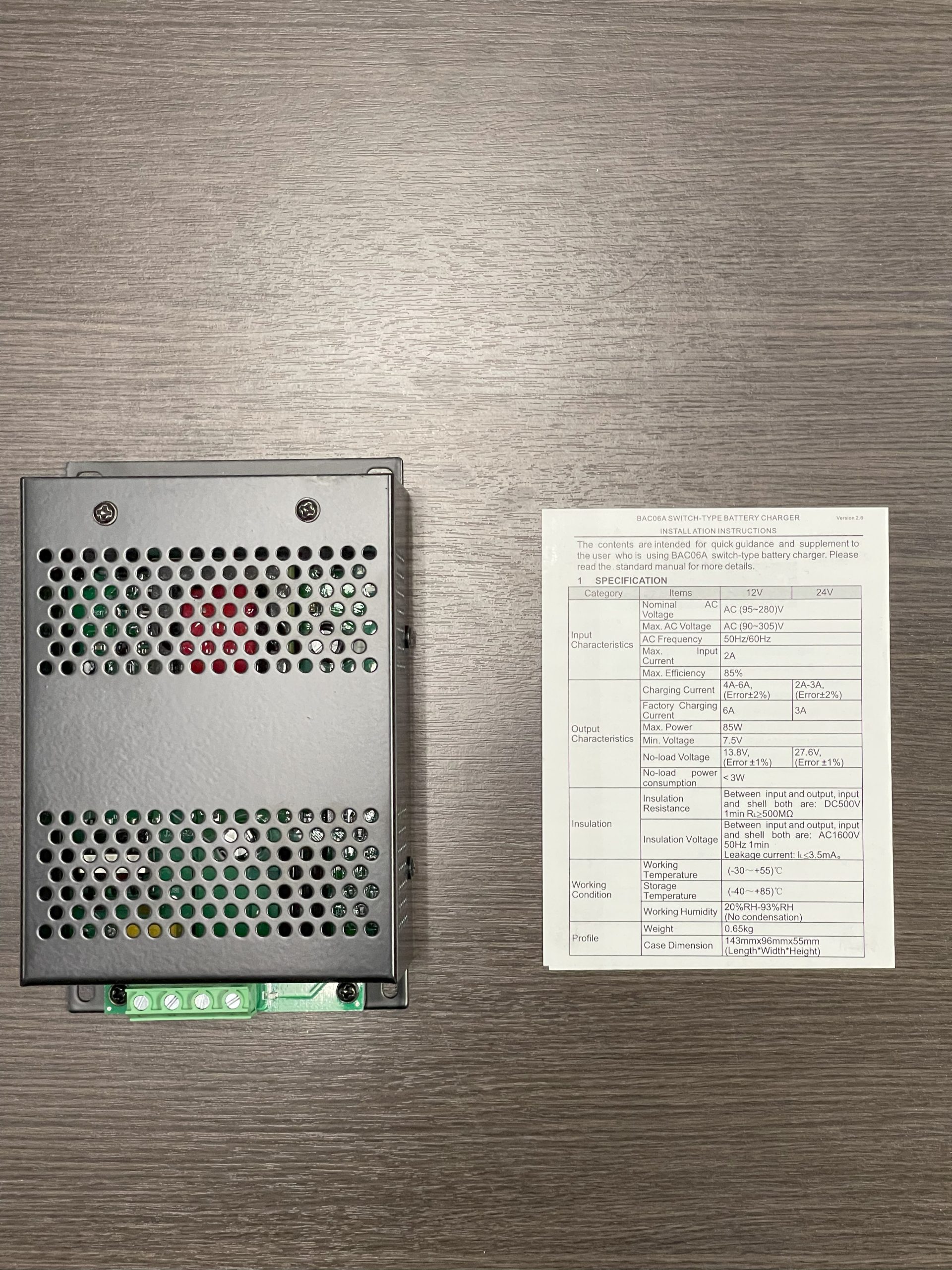
What the BAC06A does
A generator that sits idle for weeks is only useful if its starting battery is charged when the moment comes. The BAC06A solves that by continuously charging and then float-maintaining the lead-acid starter battery from an AC supply. It is a switching (SMPS) charger, which is why it can accept a very wide input range while staying small and light, and it uses a two-stage charging profile: constant current first to bring the battery up, then constant voltage to top off and hold without overcharging. That approach protects the battery from the boiling and plate damage a crude trickle charger can cause, extending service life.
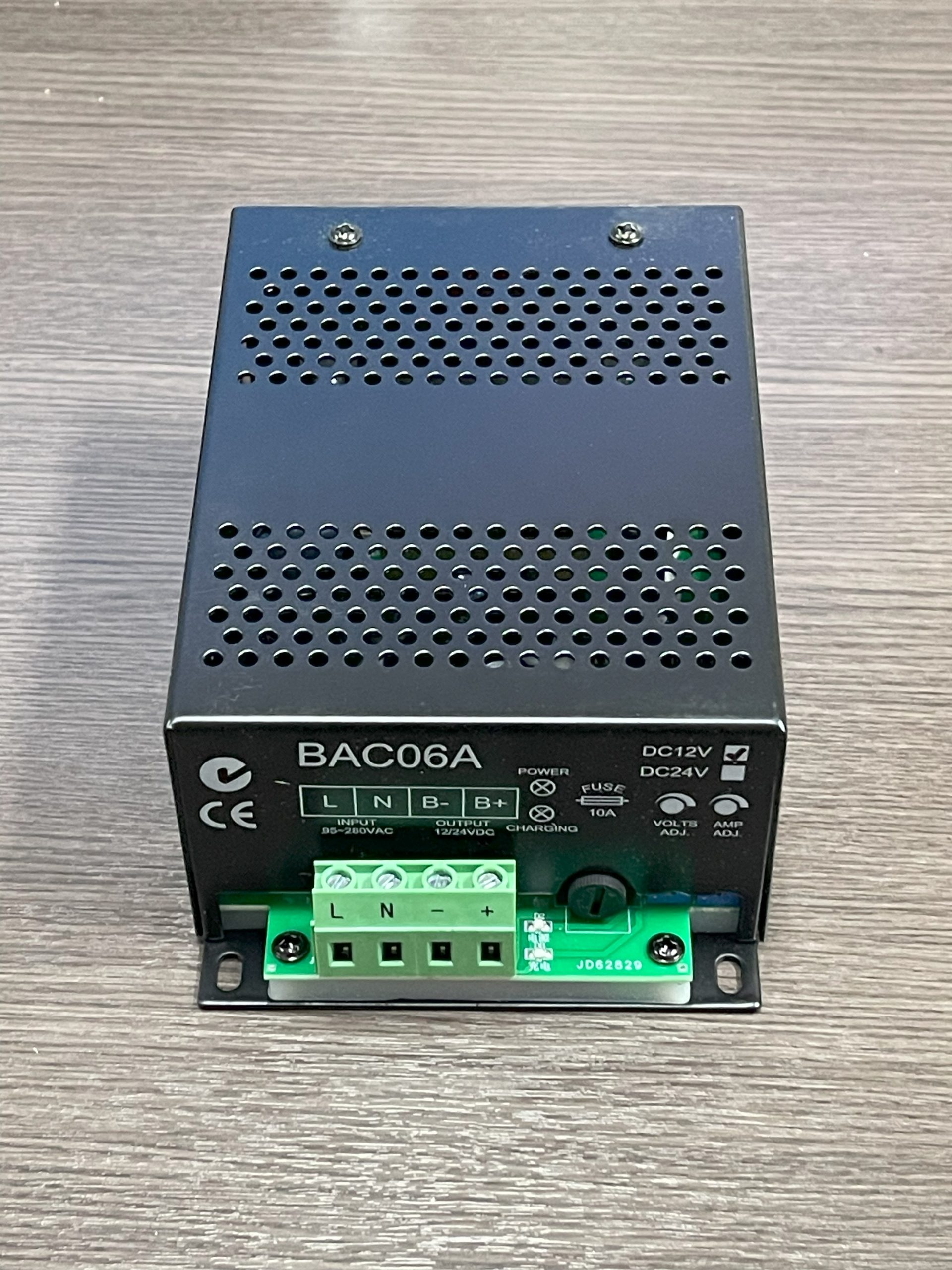
Because it is purpose-built for gensets rather than general automotive use, the BAC06A is designed to run permanently connected, tolerate a wide and sometimes unstable mains input, and sit in the harsh temperature environment of an engine room or outdoor enclosure. It provides LED indication for power and charging status and allows the charging voltage and current to be trimmed via on-board potentiometers.
Specifications at a glance
| Parameter | Specification |
|---|---|
| Type | Switch-mode two-stage lead-acid battery charger |
| Battery voltage | 12 V or 24 V (model-dependent) |
| Max charging current | 6 A (12 V model) / 3 A (24 V model) |
| Rated input voltage | 100–240 VAC |
| Max input voltage range | 90–280 VAC |
| Input frequency | 50/60 Hz |
| Max input current | 2 A |
| No-load power consumption | < 3 W |
| Operating mode | Two-segment (constant current, then constant voltage) |
| Maximum efficiency | 83% / 85% |
| Operating temperature | −30 °C to +55 °C |
| Storage temperature | −40 °C to +85 °C |
| Net weight | 0.65 kg |
| Dimensions | 143 × 96 × 55 mm |
| Protections | Short circuit, reverse polarity |
12 V and 24 V variants, and charging behavior
The BAC06A comes in two flavors that share a body but differ in output. The BAC06A-12V delivers up to 6 A into a 12 V battery, and the BAC06A-24V delivers up to 3 A into a 24 V battery—so both models sit around the same power class, roughly 72 watts of charging capacity. Choosing between them is simply a matter of matching your genset’s starting-system voltage; there is no universal auto-sensing model, so order the correct variant.
The two-stage (constant current then constant voltage) profile is the important behavior here. During bulk charging the unit holds a constant current until the battery voltage rises, then switches to constant voltage to finish and float the battery indefinitely. This is what makes it safe for permanent connection: once the battery is full, the charger settles into a maintenance voltage rather than continuing to force current, which is how it “avoids overcharging and extends battery life.” The on-board potentiometers let a technician fine-tune both the charging current and the charging/float voltage to suit a specific battery chemistry or capacity.
With a maximum charging current of 6 A (12 V) or 3 A (24 V), the BAC06A is sized for maintaining and recovering typical genset starter batteries, not for fast-charging large deep-cycle banks. That is by design—an AMF standby set needs a battery that is reliably full, not one that is cycled hard.
Input flexibility and efficiency
One of the BAC06A’s most practical strengths is its input range. It is rated for 100–240 VAC nominal but tolerates 90–280 VAC at the extremes, at 50 or 60 Hz, drawing no more than 2 A of input current. That wide window matters in real installations where the “mains” powering the charger may itself be soft, over-voltage, or supplied from varying sources around the world. The switching topology also keeps standby draw low—under 3 W at no load—and reaches a peak efficiency in the 83–85% range, so the charger is not wasting significant energy while it idles across the long periods between genset runs.
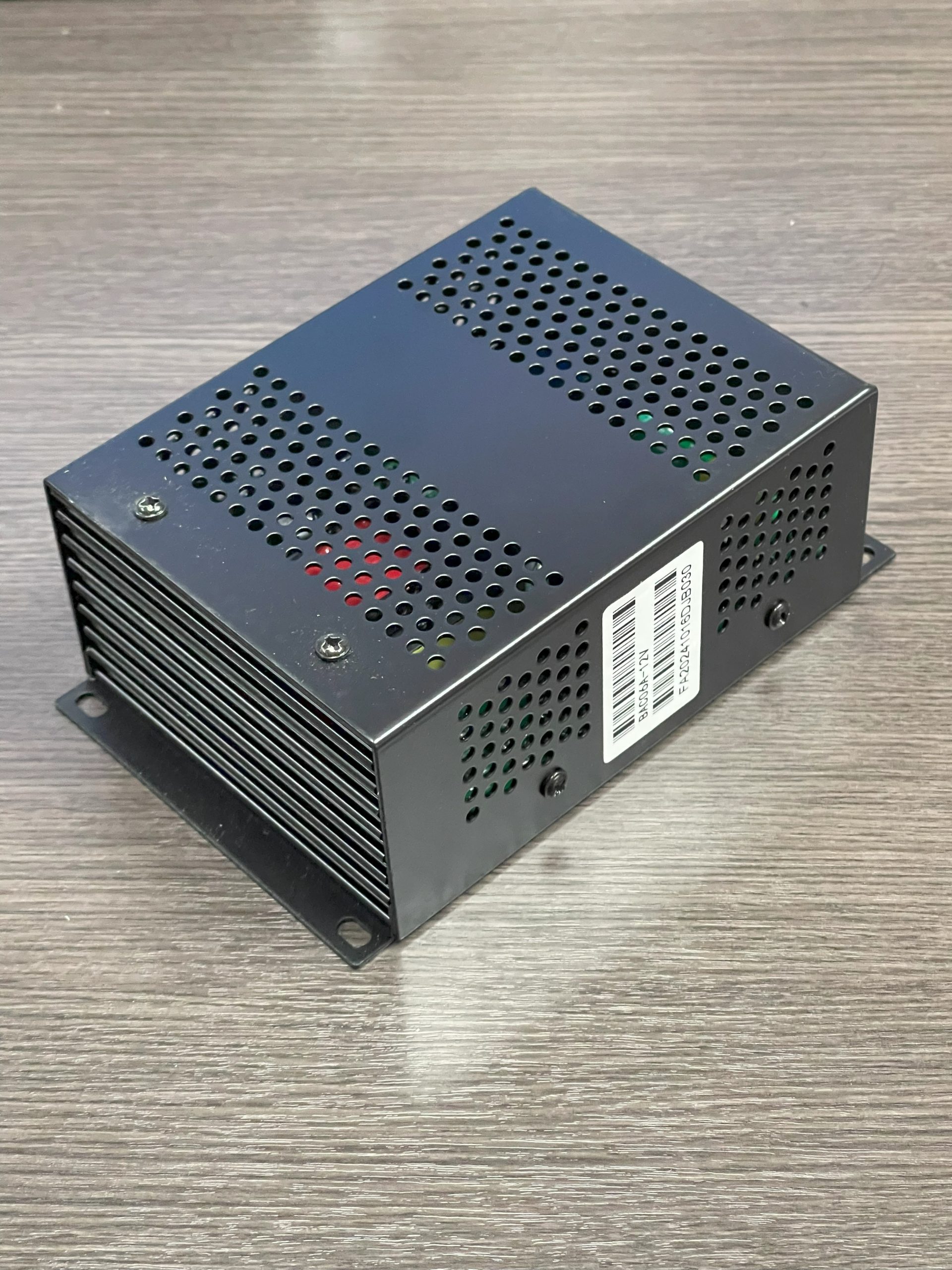
At 143 × 96 × 55 mm and 0.65 kg, it is small and light enough to mount inside most control cabinets, and its −30 °C to +55 °C operating range covers the temperature swings of outdoor and engine-room enclosures. The case gives short-circuit and reverse-polarity protection, guarding against the two most common wiring mistakes at the battery terminals.
Compatibility and wiring
The BAC06A is engine- and alternator-agnostic: it connects to the AC supply on one side and the starting battery on the other, independent of what regulator or controller the genset uses. That makes it a natural companion to a dedicated auto-start controller and voltage regulator. In a typical basic standby build it works alongside a mains-failure controller such as the Datakom DKG-105 AMF panel, which relies on a fully charged battery to crank the engine, and an alternator regulator such as the AVR SX460, which keeps the generator’s own output steady once it is running. Together the three cover charging, control, and voltage regulation for a small standby set.
Wiring is conceptually simple—AC in, DC out to the battery—but polarity and voltage matching are critical. Confirm you have the correct 12 V or 24 V model for the battery, observe correct polarity even though reverse protection is present, and set the output potentiometers to the battery manufacturer’s recommended float voltage before leaving it permanently connected.
Installation and safety considerations
Although the BAC06A is a modest low-current device, it connects to mains voltage on its input and to a lead-acid battery capable of very high fault currents on its output, so it should be installed by a qualified generator or electrical technician. Mount it in a ventilated position within its temperature rating, keep the AC and DC wiring correctly rated and terminated, and set the charge parameters to match the battery rather than leaving factory defaults if they differ from your battery’s spec. Lead-acid batteries can vent hydrogen, so the enclosure should be appropriately ventilated. As with any component wired to live conductors, isolate the supply before working on the connections and follow the manufacturer’s terminal diagram.
Pros and cons
- Strengths
- Purpose-built for genset battery maintenance with a safe two-stage charge profile
- Very wide input tolerance (90–280 VAC, 50/60 Hz) for unstable or varied supplies
- Low standby draw (< 3 W) and 83–85% peak efficiency for always-on duty
- Compact and light (143 × 96 × 55 mm, 0.65 kg) for easy cabinet mounting
- Adjustable charge voltage and current via potentiometers
- Short-circuit and reverse-polarity protection built in
- Limitations
- Modest output (6 A at 12 V / 3 A at 24 V)—for maintenance, not fast bulk charging
- Separate models for 12 V and 24 V; no single auto-ranging unit
- Two-stage profile only—no temperature-compensated or multi-stage smart charging
- Designed for lead-acid; not a lithium-specific charger
Who it’s for (and who should look elsewhere)
The BAC06A is a strong fit for anyone maintaining a standby generator with a conventional lead-acid starter battery who needs a reliable, permanently connected float charger that survives a wide input range and cabinet temperatures. It is exactly the kind of “fit and forget” component a panel builder specifies for a small AMF set.
Buyers who need higher charging current for large battery banks should look at bigger units in SmartGen’s own range (the BAC series and higher-current chargers) or comparable products such as a DSE9130/9155 or a Sonnenschein/Mastervolt industrial charger. Anyone running lithium (LiFePO4) starting batteries should choose a charger with the correct lithium profile rather than a lead-acid two-stage unit. And if you only need occasional garage top-ups rather than genset maintenance, a consumer smart charger may be more economical.
Frequently asked questions
What is the difference between the 12 V and 24 V models?
The BAC06A-12V charges 12 V batteries at up to 6 A, while the BAC06A-24V charges 24 V batteries at up to 3 A. They share the same case and input range; you simply pick the model that matches your genset’s starting-battery voltage, since there is no auto-ranging option.
Can I leave it connected to the battery all the time?
Yes—that is its purpose. The two-stage profile switches from constant current to constant voltage float once the battery is full, which avoids overcharging, and no-load consumption is under 3 W. It is designed for permanent connection in a standby genset.
What input voltage does it accept?
It is rated for 100–240 VAC and tolerates a maximum range of 90–280 VAC at 50 or 60 Hz, drawing up to 2 A. That wide window makes it suitable for installations with soft or variable mains.
Does it protect against wiring mistakes?
It includes short-circuit protection and reverse-connection (reverse-polarity) protection. You should still wire it with correct polarity and confirm the model voltage, but these protections guard against the most common errors.
Bottom line
The SmartGen BAC06A does exactly what a genset battery charger should: it keeps a lead-acid starter battery reliably full with a safe two-stage profile, tolerates a wide and messy input range, sips power while it waits, and packs it all into a small, cabinet-friendly module with the basic protections you want. Its output is intentionally modest and it is lead-acid focused with separate 12 V and 24 V models, so large banks or lithium systems need something else. But for the core job of maintaining a standby generator’s starting battery, the BAC06A is a sensible, cost-effective choice—one best installed and set up by a qualified technician alongside the set’s controller and voltage regulator.